



A new round, new opportunities
Putting employees at the centre as the new normal
HR is investing heavily in an employee-centred approach that responds to people’s personal needs, individual work preferences and unique qualities. This presents quite a challenge: how can this be balanced with the simultaneous demands for organisational control, efficiency and compliance?
In a new round of the Human Capital Incubator, Bright & Company explored the opportunities and challenges involved in developing innovative HR policies and initiatives. The findings are presented in the Brightpaper ‘A new round, new opportunities: towards tailored HRM’. Below, we share some of the key highlights.
Putting people first makes sense, doesn’t it…?
How great would it be if HR could actively respond to employees’ personal qualities, ambitions and work preferences? Emerging themes such as employee experience, happiness at work and ‘putting employees first’ are based on the belief that this contributes to a positive employee experience and, ultimately, organisational success.
Should we go all in on personalisation, freedom of choice and employee experience? For many organisations, this is an ambition that reflects a broader societal trend towards placing YOU, as an individual, at the centre. YOU are unique and want to make your own choices. Your needs, wishes and preferences come first. It is no coincidence that feeling restricted by rigid structures is one of the main reasons employees leave organisations.
At the same time, HR faces another reality: the need for organisational control, efficiency and standardisation of (HR) processes. Traditional human resource approaches still tend to focus on fitting employees into predefined processes and profiles. The ‘standard employee’ remains the norm. Anything that deviates from this is seen as problematic, driven by a strong emphasis on standardisation and control. As a result, a great deal of talent remains untapped.
One size fits nobody
The challenge is: how do you create an employee-centred approach that responds optimally to people’s personal needs, individual preferences and qualities, while also ensuring the necessary and desirable levels of organisational control, consistency and standardisation?
This challenge underlies every new HR initiative or process. With this in mind, we have developed a set of guidelines to help organisations navigate it. Our starting point is to move towards an approach that puts employees at the centre as much as possible. We have identified three guiding principles:
Principle 1 | Respond to people’s needs: Recognise employees’ needs, preferences, qualities and ambitions, enabling HR to offer tailored solutions, personalise its approach or differentiate between (target) groups of employees.
Principle 2 | Focus on what is possible: Embrace opportunities and avoid focusing too heavily on obstacles and limitations from the outset. Give people clarity about the freedom they have to make decisions, so they can contribute their own ideas and work together to find suitable solutions.
Principle 3 | Make technology and data work for people: Make smart use of emerging digital applications and data technologies. Provide HR services that make people feel exceptionally well supported and pleasantly surprised by the assistance they receive. Through tools, apps and personalised insights, employees can be given the support they need while making their working lives as easy as possible.
Between aspiration and reality
Behind each principle lies a more complex reality. The ideas behind the ‘employee-centred’ approach may seem obvious or appealing, but putting them into practice is another matter. Alongside the opportunities and possibilities, the realities of day-to-day work can be challenging. From both an organisational and an individual perspective, there are important considerations to take into account from the outset when deciding how far you can and want to go in designing new HR policies. We recognise that the trend towards personalisation and ‘employee experience’ does not automatically mean that an organisation should adapt to every individual employee. Doing so could create undesirable situations for both employees and the organisation. ‘One size fits all’ is not desirable, but neither is ‘one size fits one’. The challenge is therefore to find the optimal fit each time.
The standard for tailored solutions
The considerations involved in designing new HR policies are often made implicitly. In the Brightpaper ‘A new round, new opportunities: towards tailored HRM’, we explore the design process behind new HR applications. We provide a framework for making the right choices from the outset, ensuring optimal impact in both development and implementation. The framework consists of three steps:
- Focus and scope
- Balancing interests
- Taking a clear position
To make the framework more practical, we have also developed a concrete example focusing on workload. A must-read for everyone involved in building future-fit HR.
About the author


In practice, organisations often struggle to align their ambitions for employees, leadership and collaboration. The whitepaper Human Capital Ecosystem explores how to examine and strengthen both the visible and underlying dynamics within your organisation.
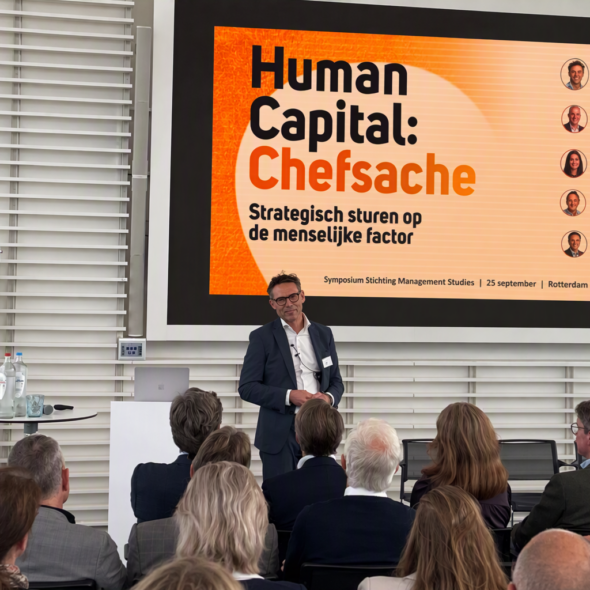
People are not resources, but assets to businesses. Human capital belongs on the boardroom agenda and is a matter for top leadership. Discover more in the book Human Capital: Chefsache!

For an organisation, we not only developed an HR strategy with broad support, but also set the HR function in motion from the outset. By combining strategy development with organisational development, we fostered ownership, a shared direction and the ability to deliver.

For one of the Netherlands' four largest municipalities (G4), we translated the projected workload involved in tackling electricity grid congestion into the staffing capacity and skills required. We also developed a scenario-based model to help the organisation plan ahead and make informed decisions.